
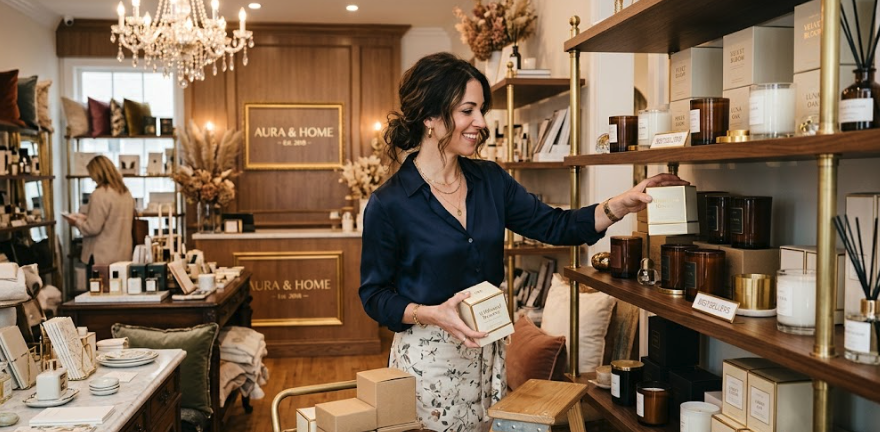
If you’ve ever wondered how to tell if a wholesale buyer is serious, this situation will probably feel familiar. A store owner stops at your market booth. She picks up your candles, reads the labels, smells three in a row. Then she says, “I own a shop downtown. I love these. Do you wholesale? Send me your line sheet.”
You go home and send the nicest email you’ve ever written. And then nothing. A week passes. Then two. You draft a follow-up, delete it, draft it again. By week three you’ve decided your product wasn’t good enough after all.
If you sell a physical product and you want to get it onto boutique shelves, you have probably lived some version of this. What most makers never learn is that the silence usually has nothing to do with the product. It comes from never sorting the real buyers from the polite ones. If you want to know how to tell if a wholesale buyer is serious, these two questions can help you sort the real buyers from the polite ones in under a minute.
“I love this” is a social signal, not a buying signal
Here is the part that stings. When a shop owner says “I love this,” “do you wholesale,” or “send me your catalog,” she is often just being kind. Those are the words a nice person uses when she likes your work and wants the conversation to end warmly.
Sometimes those exact words are also the opening line of a real buyer. The problem is that you can’t tell the difference from the words alone, because the words are identical. So how do you tell if a wholesale buyer is serious? You find out whether she has a place for your product and a time to buy it.
Think about it from her side. A boutique owner walks a market or scrolls Instagram and sees fifty makers she likes. She says “I love this” to most of them and means it. She orders from maybe three. The difference between the three and the other forty-seven has nothing to do with which products she liked most. It comes down to whether she has a place for it and a time for it.
That is the whole framework. A real buyer has a shelf and a calendar. If she has both, she’s real. Just missing one? She’s a maybe. If she’s missing both, she’s a fan. Fans are lovely, but you don’t send fans a line sheet and then wait three weeks in agony.
Question one: “Where do you see this in your store?”
Ask it warmly and with real curiosity. A buyer who is actually considering your product has already placed it in her store in her head, before she ever walked up to your table. When you ask, she doesn’t have to think. She tells you what she already sees.
A real answer sounds like this: “Right by the register. I have a little gift section where people grab things under thirty dollars on the way out.” Or, “I carry a soap line that does really well and these would sit next to it.” Or, “I’ve been looking for something for my front window for fall.” Notice what she gave you. A location, a price point, a neighboring product, sometimes a season. She’s describing a plan.
A polite answer sounds like “Oh, I don’t know, it’s all so cute,” or “I’d have to think about it.” She isn’t lying. She just doesn’t have a shelf yet, and a buyer with no shelf won’t place an order no matter how good your follow-up is, because there’s nowhere for the product to go.
If most of your wholesale interest comes through Instagram, the DM version works the same way. Someone messages “love your stuff, do you wholesale?” and you reply, “I do! Tell me about your shop. Where do you picture these fitting in?” A real buyer writes you a paragraph. A browser hearts the message.
This question is doing two jobs. It qualifies her, and it also sells for you. The moment she describes your product next to her register, she is picturing it there. If she answers with specifics, write them down immediately. That is the opening line of your follow-up email.
Question two: “When are you bringing in new product next?”
If you prefer the industry phrasing, ask, “When’s your next buying window?” Either version works.
Almost nobody asks this, and it’s the one that saves you weeks of hoping. Boutiques don’t buy when they fall in love with something. They buy when they buy. Some shops place two or three big orders a year, planned months out. Other stores add a little every month. Some only buy for holiday and are finished by September. Many small shop owners have a budget for the season, and when it’s spent, it’s spent. Retailers call that open-to-buy. You don’t need to use the term, but you do need to know it exists.
So when a store owner says “I love this” in November and her next buying window is February, she isn’t ordering in November. It doesn’t matter how good you are. There’s no calendar.
A real answer sounds like a date. “Spring orders in January.” “I’m buying for holiday right now, this is the week.” “Just got back from market, so probably not until March.” Even the March answer is gold, because now you know exactly when to follow up, and a follow-up in March is simply the appointment she gave you.
This question also solves the “I don’t want to be pushy” problem. Follow-up feels pushy when you’re guessing at the timing. Once she’s told you the window, you’re keeping an appointment: “You mentioned you’d be doing spring orders in January, so here’s the catalog, and I’ve flagged the three scents my other shops are ordering for spring.”
What to do with the answers
She has a specific spot and a specific time. She’s a real buyer. Send your catalog that day, open with her own words about where it’s going, name the date she gave you, and actually check back on that date.
She has one but not the other. She’s a maybe, worth a little effort but not a lot. Send the catalog, keep it short, and ask permission: “Is it okay if I check back when you’re planning your next order?” If she says yes, calendar it and let it go until then. If she doesn’t answer, let it go, period.
She has neither. She’s a fan. Thank her, mean it, hand her your card, and release her. She gave you a compliment, not an opportunity, and you’re allowed to receive the compliment and move on.
Most of the emotional damage in wholesale doesn’t come from rejection. It comes from unqualified hope. You gave full weight to someone who was never carrying any, then blamed your product when it didn’t hold.
Learning how to tell if a wholesale buyer is serious means you can stop treating every expression of interest like an opportunity—and start giving your time and follow-up to the buyers who have actually given you something concrete to work with.
Write the two questions down before you need them
Open your notes app. Line one: “Where do you see this in your store?” Line two: “When are you bringing in new product next?” Under those, write what you’ll do with each kind of answer. Then use them in your next three conversations with anyone who shows interest, at a booth or in your inbox, and notice how different it feels to know instead of hope.
And if you can spot the real buyer but still freeze when it’s time to talk numbers and minimums, that’s exactly what we work on inside the Faire Accelerator. You can hear the full episode, including the market-booth and DM versions of both questions, on Episode 236 of She Sells Differently.

Andee Hart is an award-winning sales executive who walked away from traditional success to reinvent how product-based businesses grow. After nearly 20 years in corporate America, she turned a kitchen-counter candle experiment into Hart Design Co, a wholesale brand carried by hundreds of boutiques across North America. That experience became the foundation for She Sells Differently, where Andee is teaching emerging product brand owners to redefine what it means to sell by serving with excellence, growing with strategic purpose, and shining as a light in the marketplace.

